Before you can pick a specific mattress, you have to pick a category. Memory foam, hybrid, and innerspring are the three dominant types in 2026 — and each one solves different problems, fails in different ways, and works for different sleepers. Here’s how to choose between them.
The 30-Second Answer
- Memory foam: Best for pressure relief, motion isolation, and side sleepers. Worst for hot sleepers and people who hate the “sinking” feeling.
- Hybrid: Best for most people. Balanced support, cooler sleep, and works across sleeping positions. Most expensive of the three on average.
- Innerspring: Best for hot sleepers, traditionalists, and the lowest budgets. Worst for couples (motion transfer) and pressure relief.
Memory Foam: How It Works and Who It’s For
Construction
Memory foam mattresses use multiple layers of viscoelastic polyurethane foam. The top contour layer responds to body heat and weight, conforming to your shape. Below sits transition foam, then a high-density support core.
Best for
- Side sleepers (pressure relief at shoulders and hips)
- Couples where one person is a light sleeper (excellent motion isolation)
- People with chronic pressure-point pain
Worst for
- Hot sleepers (foam traps heat, even with gel)
- People who change positions a lot at night (foam slows you down)
- Heavier sleepers (foam compresses, base feels closer)
Top picks
For traditional memory foam: Nectar Original. For grid-style alternative: Purple Original.
Hybrid: How It Works and Who It’s For
Construction
Hybrid mattresses combine a foam comfort layer (memory foam, latex, or polyfoam) on top of a pocketed-coil support base. The coil base is the key — it provides bounce, breathability, and durability that all-foam beds can’t match.
Best for
- Most sleepers (it’s the safest bet)
- Combo sleepers who change positions
- Hot sleepers who still want some contour
- Heavier sleepers (coils support better than foam)
Worst for
- Buyers under $700 (good hybrids start at $800+)
- Apartment dwellers in walk-ups (heavy beds, hard to maneuver)
Top picks
Luxury: Saatva Classic. Mid-range: DreamCloud Premier. Zoned support: Helix Midnight Luxe.
Innerspring: How It Works and Who It’s For
Construction
Traditional innerspring uses a coil unit (Bonnell, offset, or pocketed) with thin foam or fiber comfort layers on top. No deep cushioning. Bouncy, breathable, classic feel.
Best for
- Hot sleepers (best airflow of any type)
- Stomach sleepers (firm flat surface)
- Traditionalists who grew up sleeping on innersprings
- Lowest budgets (cheapest queens often start here)
Worst for
- Side sleepers (pressure points)
- Couples (motion transfer, especially Bonnell coils)
- Anyone with chronic pain (no contour)
Top pick
The market has largely shifted away from pure innerspring. Most “innerspring” beds you’ll see today are technically hybrids. For a true innerspring feel, the Saatva Classic (which uses dual coils) is closest to the classic experience.
How to Decide
Ask yourself three questions:
- How do you sleep? Side = memory foam or hybrid. Stomach = firm hybrid or innerspring. Back = hybrid (any flavor).
- Do you sleep hot? If yes, hybrid or innerspring. If no, any.
- What’s your budget? Under $600 = memory foam (best value). $600-1200 = hybrid (sweet spot). $1200+ = luxury hybrid or premium memory foam.
What About Latex?
Latex is a fourth category we left out because it’s less common in 2026 and considerably more expensive ($1,500+ typical). It’s an excellent material — bouncy, cool, durable, naturally hypoallergenic — but the price puts it out of reach for most buyers. If you want latex, Saatva Latex Hybrid is the most accessible entry.
Common Mistakes
- Buying memory foam without testing: The sinking feeling isn’t for everyone. Most online beds have 100+ night trials — use them.
- Buying based on price alone: A $400 hybrid will sag in 3 years. A $400 memory foam might last 7. Match the type to your needs first, then optimize for price.
- Trusting “cooling” claims at face value: All beds claim to sleep cool. Hybrids and innersprings actually do. Memory foam claims are usually marketing.
FAQ
Is hybrid worth the extra cost over memory foam?
For most buyers, yes. Hybrids last 2-4 years longer on average and work for a wider range of sleepers. The extra $200-400 amortized over a decade is worth it.
Why don’t more people buy innerspring?
The category lost ground because of motion transfer (bad for couples), lack of pressure relief, and shorter lifespan with cheaper coil systems.
Where can I see specific picks?
See our main best mattresses guide or our back pain picks.
A reminder: Mattresses 4 All earns commissions on products linked above. We’ve tested examples of all three categories — the recommendations reflect our honest assessment of fit, not commission rates.
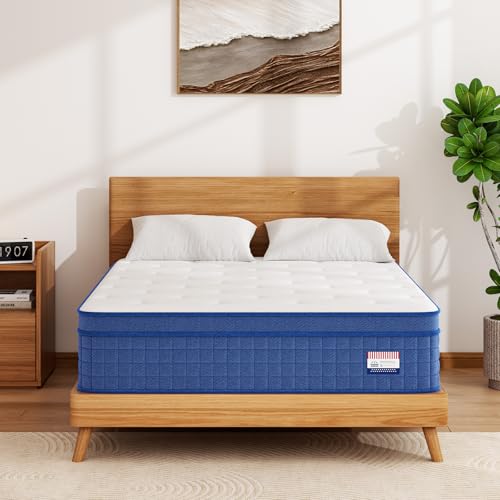
Full Size Mattress, 2026 Upgraded 8 inch Hybrid Full Mattress in a Box, Full Size Memory Foam Mattress with Cooling Gel, Pocket Springs, Luxury Colchones Full for Pressure Relief, Motion Isolation
- Ultra Quiet: Built-in high quality Individual pocket spring and slow springback foam,can effectively absorb the noise and vibration caused by tossing and turning when sleep,no waking up by the noise,not disturb companion and effectively reduce your turning times,let you sleep soundly and peacefully
- Breathable & Skin-Friendly Fabric:Mattresses has a high-end,skin-friendly and breathable knit fabric with a comfortable and breathable surface,absorbing moisture and balancing body temperature. helps to wick away moisture and dissipate body heat.Great temperature control thanks to innovative heat-dissipating side net cloth around the cool memory foam and strong airflow circulation of pocket springs underneath,creating a comfortable sleep experience
- Effective Pressure Relief Design:This Mattress is designed with 3 layers of adaptive CertiPUR-US certified memory foam and 7-zoned pocket springs that,provide low motion transfer and effectively cushion high-pressure areas of the body,keeps you away from back pain.Gel memory foam that conforms to the body’s curves,effectively relieving fatigue and pressure,make your side sleep more comfortable.
New starting from: 569.00 $
Go to Amazon